Inside EVaaS: A New Model for Airport Fleet Electrification
Sustainability Partners’ Arnold Albiar discusses how a service-based approach is helping airports and public agencies deploy and manage electric fleets more efficiently.
According to Sustainability Partners, the EVaaS approach bundles vehicle procurement, customization, charging infrastructure coordination, and ongoing maintenance into a single, scalable solution, helping public agencies reduce upfront costs, simplify implementation, and ensure long-term operational reliability.
Credit:
METRO
3 min to read
Arnold Albiar from Sustainability Partners explains how a service-based model is enhancing the deployment of electric vehicle fleets at airports.
This new Electric Vehicle as a Service (EVaaS) approach aids airports and public agencies in managing electric fleets more effectively.
The strategy focuses on improving operational efficiency and sustainability in airport fleet electrification initiatives.
*Summarized by AI
As airports and public agencies accelerate their transition to zero-emission transportation, innovative delivery models are emerging to help overcome the financial and operational challenges of fleet electrification.
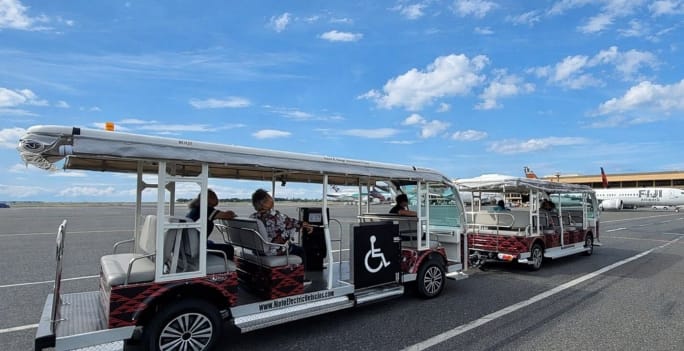
At Honolulu’s Daniel K. Inouye International Airport, Sustainability Partners recently supported the deployment of three electric trams for the Wiki Wiki Shuttle. This intra-airport service moves thousands of passengers daily between terminals and concourses.
Ad Loading...
Delivered through Sustainability Partners’ Electric Vehicles as a Service (EVaaS) model, the project replaces older, higher-emission vehicles with quieter, more energy-efficient electric units while enhancing the passenger experience.
According to Sustainability Partners, the EVaaS approach bundles vehicle procurement, customization, charging infrastructure coordination, and ongoing maintenance into a single, scalable solution, helping public agencies reduce upfront costs, simplify implementation, and ensure long-term operational reliability.
As part of Hawai‘i’s broader push toward fleet electrification, the project also reflects a growing shift toward programmatic, service-based approaches that allow agencies to scale sustainable transportation initiatives more efficiently.
METRO spoke with Arnold Albiar, managing partner for Hawai‘i at Sustainability Partners, about the deployment, the benefits of the EVaaS model, and how this approach is helping public agencies move forward with electrification while maintaining reliable, day-to-day operations.
About the EVaaS Model and HNL
What does Sustainability Partners’ EVaaS model cover for HNL beyond vehicle delivery?
Sustainability Partners’ EVaaS model delivers a fully bundled infrastructure solution rather than a one-time vehicle purchase. At Daniel K. Inouye International Airport, this includes the electric trams, infrastructure, deployment, training, and ongoing maintenance support to ensure the fleet remains safe, reliable, and performs over time.
Ad Loading...
EVaaS integrates assets and long-term support into a single package. This allows the airport to focus on passenger mobility and operations, while we provide the underlying infrastructure.
How does EVaaS reduce complexity or risk for public agencies, such as airports?
Sustainability Partners’ model helps public agencies overcome procurement hurdles, capital constraints, and long asset planning cycles. EVaaS simplifies implementation by providing a single solution hub, a quarterback, if you will, bringing together design, construction, OEM coordination, charging systems, and ongoing maintenance under one agreement.
Rather than managing separate contracts with consulting firms, general contractors, engineering firms, equipment providers, and service partners, airports can work with a single partner responsible for delivery and long-term performance. This unified structure reduces administrative burden, limits finger-pointing between vendors, and streamlines communication throughout the project lifecycle.
For airports managing aging fleets, evolving sustainability mandates, and passenger growth, this approach reduces financial uncertainty, enhances operational performance, and strengthens accountability from day one.
Delivered through Sustainability Partners’ Electric Vehicles as a Service model, the project replaces older, higher-emission vehicles with quieter, more energy-efficient electric units while enhancing the passenger experience.
Credit:
Sustainability Partners
The Ongoing Partnership and Scalability
What ongoing maintenance, performance monitoring, or lifecycle support is included?
The EVaaS structure ensures vehicles remain operationally dependable and service-ready by facilitating maintenance, repairs, and support, and aligning and maximizing charging infrastructure with performance requirements.
Ad Loading...
Rather than viewing the trams as a static purchase, the model supports continuous performance and reliability, with planned upgrades over time. This helps avoid deferred maintenance issues and unexpected large capital expenditures that often occur with traditionally procured fleets.
How scalable is this model for other airports or larger transit fleets?
The model is highly scalable and adaptable across a wide range of fleet types and operating environments. EVaaS can support everything from airport shuttle trams and parking transport vehicles to electric buses, vans, light-duty and heavy-duty service vehicles, maintenance fleets, and other specialized transit equipment.
Because EVaaS integrates vehicles, charging infrastructure, and long-term support, it can be tailored to small closed-loop systems like the Wiki Wiki Shuttle or expanded to serve larger municipal transit fleets, regional airport systems, university campuses, ports, and other public-sector mobility networks. The model is designed to grow alongside operational needs, whether that means adding new vehicle classes, expanding charging capacity, or modernizing additional fleet segments over time.
Quick Answers
EVaaS stands for Electric Vehicles as a Service, which is a service-based approach to deploying and managing electric vehicle fleets at airports and other public agencies.
Arnold Albiar is associated with Sustainability Partners and discusses how their service-based model is facilitating efficient deployment and management of electric fleets at airports.
A service-based approach allows airports to adopt electric fleets more efficiently by outsourcing deployment and management, reducing upfront costs, and leveraging expert oversight.
Fleet electrification helps airports reduce their carbon footprint, comply with environmental regulations, and improve sustainability efforts by transitioning to cleaner energy sources.
Airports may face challenges such as high initial costs, infrastructure limitations, and operational management, which service-based models like EVaaS aim to address.
Coalition leaders outline priorities for preserving bus funding, maintaining competitive grants, and ensuring flexibility for transit agencies nationwide.
Two battery-electric buses entered service on Earth Day, with four additional vehicles expected to join the fleet this summer. Seven more buses are planned for the end of 2027, bringing Metro’s total zero-emission fleet to 13.
A 5% rise in deliveries and a surge in zero-emission buses signaled progress in 2025, but high costs, long lead times, and shifting funding priorities continue to cloud the outlook.
In Part 1, Blandon shares his journey from the U.S. Marines to a leadership role in public transit, along with insights on mentorship and professional growth within the industry.
In this conversation, TBC’s Executive Director Ed Redfern, President Corey Aldridge, and Washington Representative Joel Rubin outline the coalition’s key policy priorities, the challenges facing transit agencies, and how industry stakeholders can work together to strengthen the voice of bus transit at the federal level.
CALSTART’s latest Zeroing in on ZEBs report shows continued nationwide growth despite supply-chain challenges. The group’s Deputy Director of Transit, Mike Hynes, talked to METRO about how agencies are adapting procurement strategies, fleet plans, and more.
Even amid shifts in federal funding, California continues to advance its zero-emission agenda, enforcing and funding its regulatory framework despite federal obstacles.